The Receipt Leak Toolkit. Stop losing job-level profit to untagged receipts.
The bank feed catches every receipt. Your job-cost report doesn't. The gap is what's making your next similar bid low. One free download — the 12-month Excel tracker that mirrors the Receipt Leak Calculator — that closes the gap one month at a time.
"The IRS gets the right number. Your pricing doesn't."
A quick take from Joe on what untagged receipts cost you — not on the tax return, but on the very next bid. The toolkit on this page makes the fix repeatable across 12 months.
One workbook. Twelve months of receipts-to-jobs tracking.
The same six inputs as the online calculator — crew size, receipts per week, untagged %, average receipt $, planned bid GM %, similar jobs per year — logged every month. The zone meter is built in. After three months the bidding gap is documented; after six the trend is undeniable.
- Monthly tracking tab — 12 rows, same inputs and outputs as the calculator
- Zone meter on every row — healthy / fixable / bidding wrong / very wrong
- Methodology mirror — the six formulas printed inline so you can defend the number
- Free. No upsell. Built around the receipt-leak framework on the show.
Receipt Leak Tracker
A workbook that mirrors the Receipt Leak Calculator and turns one-time inputs into a 12-month picture. Each month: enter the same six sliders, read the same zone, watch the trend close (or not).
- Monthly tracking grid — same six inputs as the calculator
- Auto-zone color coding (healthy / fixable / wrong / very wrong)
- Per-job under-bid risk computed each month
- 12-month trend line so the progress (or lack of it) is visible
The six formulas + the four zones
The same math the online calculator runs — receipts/year, untagged $/year, per-job overstatement, per-job under-bid risk — printed in the workbook so you can defend the number to a CPA, a partner, or yourself.
- Six formulas, with worked examples
- Zone definitions: <5% healthy, 6–15% fixable, 16–25% wrong, 26%+ very wrong
- The §0.10 myth-buster on why this isn't a tax problem
- Behind the Books episode link inside the file
The four untagged-receipt zones.
Every month your untagged rate lands in one of four zones. The toolkit makes the rate visible. The fix is the same in every zone — just less urgent the lower you go.
Bidding is honest.
Almost every receipt is making it onto a job. Your job-cost report is telling the truth. Keep the daily tagging habit and the trend stays here.
A receipt-capture habit closes it.
Bidding is off by a small but real margin. A daily field-side receipt-capture process — phone photo, tagged to a job, same day — closes most of the gap in 30 days.
Next similar bid will be low.
Job-cost reports are systematically overstating profit. If you're reusing those numbers as the benchmark for the next bid, the next bid is going to come up short. Fix the process now.
Stop bidding off the old jobs.
More than a quarter of your receipts aren't reaching your job-cost report. Whatever your last similar job said it earned, your next bid based on it is materially low. Re-cost recent jobs before pricing the next one.
Three steps. One workbook. Twelve months.
Field-side receipt capture
Every receipt photographed and uploaded the same day, by the person who bought it. No shoeboxes. No glove-box piles. No "I'll deal with it Friday."
Tag every receipt to a job
When the receipt is uploaded, it gets a Customer:Job tag — or a clear non-job code (overhead, vehicle, tools). Untagged means hidden. The toolkit measures the untagged rate every month.
Log the monthly numbers
Drop the month's six inputs into the workbook. Read the zone. Read the per-job under-bid risk. After three months the picture is clear; after six the bidding correction is documented.
The episode this toolkit was built for.
Joe walks through why missing receipts don't break your tax return — they break your bidding. The math is the same every time: the bank feed catches everything, your job-cost report only catches what got tagged, and the gap is what's making your next bid low. The toolkit on this page is the system from the episode.
Watch on YouTube →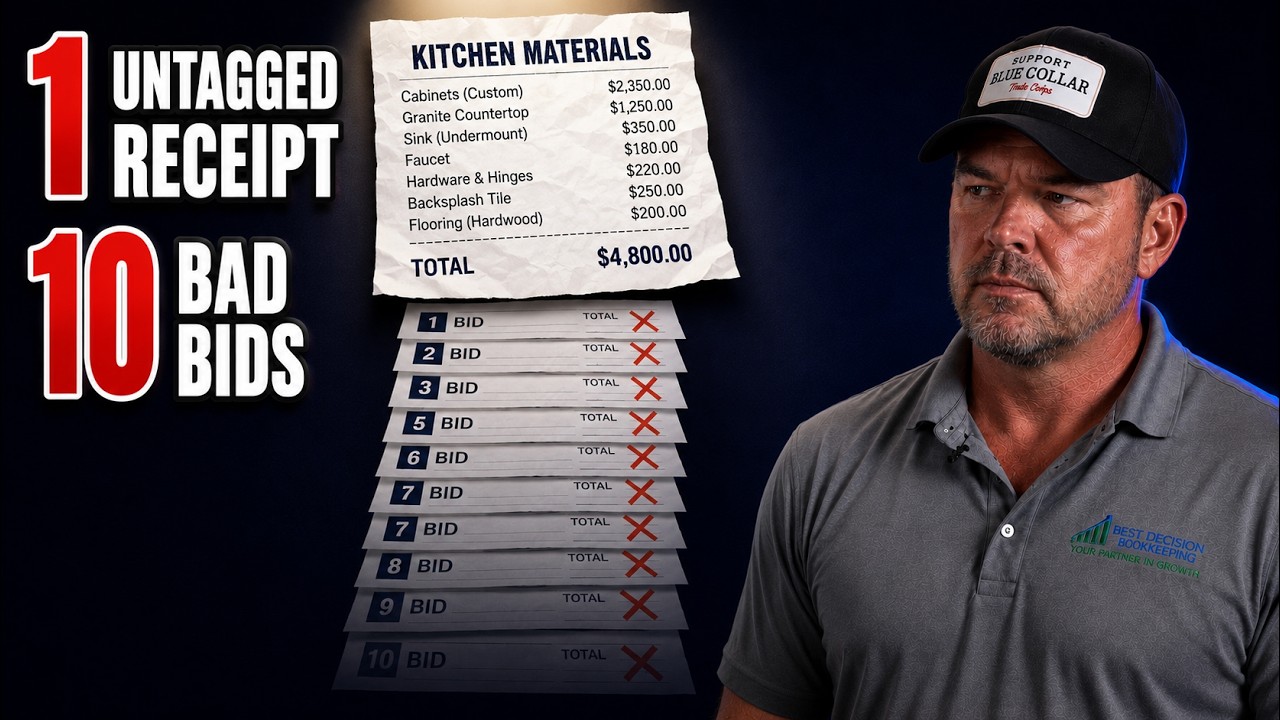
Use it with the calculator. Stack it with the sibling toolkit.
Receipt Leak Calculator
The interactive version of the same math. Move six sliders, see your zone, see the per-job under-bid risk in real dollars. Run it once before you start tracking, then once a month to compare.
Run the calculator →Receipt Organization Toolkit
Receipts that don't get captured at all are upstream of receipts that don't get tagged. The Receipt Organization Toolkit is the 10-minute weekly routine + tagging kit that feeds clean inputs into this tracker.
Get the receipt organization toolkit →Pair it with these.
Job Cost Tracking Toolkit
The 30/35/45 gross-margin framework plus a 30-job Excel tracker. Once receipts reach the right job, this turns the data into a bidding pattern.
Get the toolkit →Monthly Metric Tracker
The 7 numbers we walk through with clients every month. Pair it with the Receipt Leak tracker for a full owner dashboard.
Download →Financial Health Checklist
The 12-point owner checklist we walk through with every new client. Spot what's broken before it costs you.
Download →If untagged receipts are bending your bids, we can install the system.
Best Decision Bookkeeping installs receipt-capture and job-tagging workflows for contractors and trade businesses. 30-minute call. No pitch. We'll walk your books and tell you what's missing.