See how much your job profit
is overstated.
When receipts hit the bank but skip the job, the IRS still gets the right number — but your next bid doesn't. Move the slider to your honest untagged rate. The number on the right is what your next similar bid will be low by.
Watch first · 47 seconds
"The IRS gets the right number. Your pricing doesn't."
A quick take from Joe on what untagged receipts actually cost you — not on the tax return, but on the very next bid. The slider math below shows it in dollars.
Your numbers
Where your receipts end up
What it costs your bidding
Where your untagged rate lands
If your last 10 similar bids ran like this…
The IRS got the right number off your bank feed. Your pricing didn't.
Methodology & Sources
How the math works. Every number on this page is a transparent calculation from your slider inputs. There are no industry-stat claims — only your numbers, run through the formulas below.
receipts/year = crew × receipts/wk × 52
untagged/year = receipts/year × untagged %
untagged $/year = untagged/year × avg receipt $
per-job overstatement = (untagged $/year) ÷ (similar jobs/year)
per-job under-bid risk = per-job overstatement × (1 + planned GM %)
cumulative loss/year = per-job under-bid × similar jobs/year
What this calculator does NOT claim. It does not cite an industry "average receipt-leak rate" or an "average contractor untagged %." Those would be industry-stat claims that need a real source. This tool is your slider × your math — pick the rate that's true for your business.
Sources. The §0.10 framing on what the bank feed actually catches is built into how QuickBooks Online and any modern bank-feed bookkeeping works — it's a product fact, not an industry stat. The Excel companion has the same explanation on the "Methodology — Cited" / "— Examples" / "— Sources" tabs (all empty for this tool — by design).
From Behind the Books · The show
The episode behind this calculator.
Joe walks through why untagged receipts break your bidding even though the IRS still gets the right number — and the daily receipt-tagging habit that closes the gap in 30 days.
Watch on YouTube →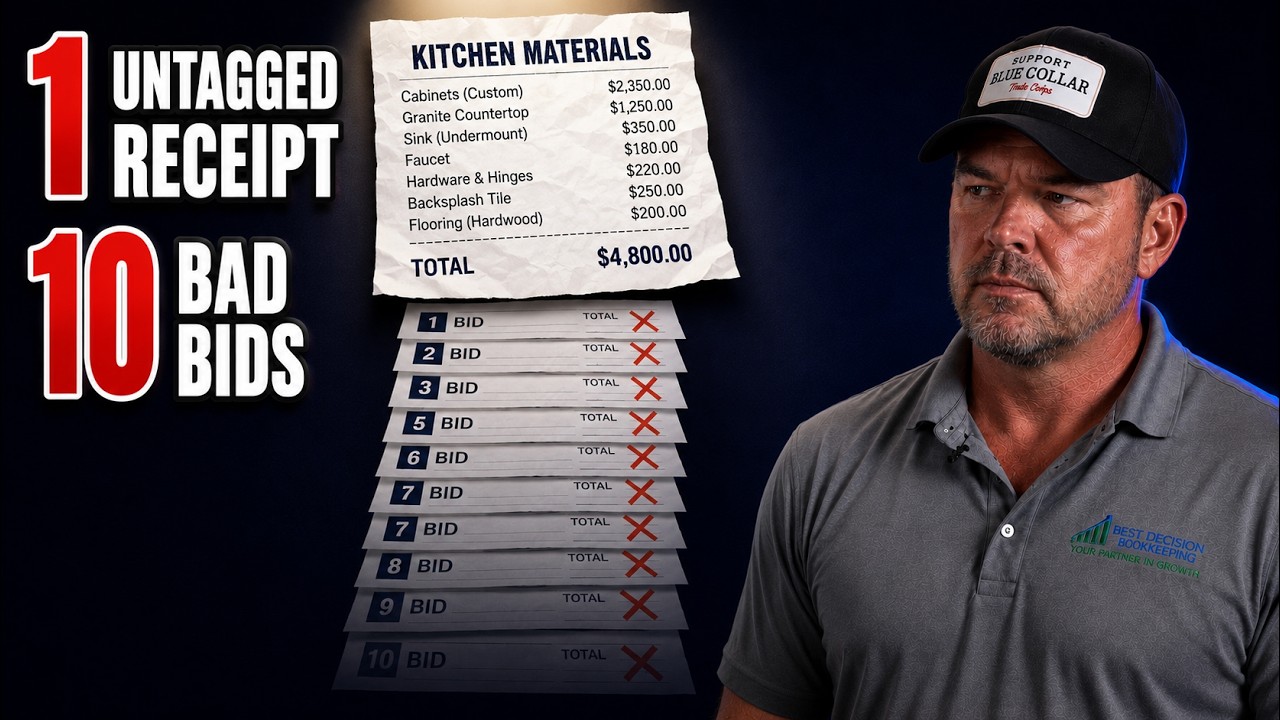
Companion toolkit
The calculator names the gap. The toolkit closes it month by month.
This page shows what each percentage point of untagged receipts is costing your bidding right now. The free Receipt Leak Toolkit is the 12-month Excel mirror — log your monthly untagged rate, watch the zone meter move, and prove the fix is working.
- ■ Receipt Leak Tracker (Excel) — same six inputs as this calculator, twelve months of tracking, the same zone meter on every month
- ■ Methodology mirror — the six formulas from the calculator, printed inline so you can defend the number
- ■ Behind the Books episode link — the show that walks through why this matters