Stop guessing your prices.
Find the bid that actually pays.
Most contractors price by intuition. The dollar left at the end of the job feels like profit, but it has not met the rent, the insurance, the trucks, depreciation, or the owner's draw yet. Plug in your real numbers and see the bid that pays for everything — plus the floor where you should walk away.
Watch first · 40 seconds
The dollar left at the end of the job isn't profit yet.
A quick take from Joe on the margin-vs-markup trap — why pricing off your gut quietly funds losses, and what this simulator is really showing you about the bid that pays for everything.
The trap most contractors fall into
$10,000 cost
$10,000 × 1.30 = $13,000 price
Gross profit = $3,000
$10,000 cost
$10,000 ÷ 0.70 = $14,286 price
Gross profit = $4,286
Your job costs
Your business targets
Markup required to hit your margin
Your intuition vs the math
Type in the price you would have bid. The card on the right shows the math-driven price that hits your target margin. The gap between them is what you'd give away if you went with your intuition.
What you would have bid
The math that hits your target margin
Where your intuition lands — for YOUR business
The four zones below are built from the two numbers you entered above — your overhead % and your income target. Danger is anywhere your margin is below your overhead, so the job doesn't cover the bills. Fragile covers overhead but misses your income target. Healthy hits your target. Strong beats it by 10 points or more. The marker shows where your intuition price actually lands.
What if something goes wrong?
Your required price assumes the job runs exactly the way you bid it. Move the sliders to walk through "what if materials go up 15%" or "what if this job takes 2 extra days." The result box shows where your margin actually lands — at the same required price, with the job costing more than you planned.
Your bid recommendation
The required price hits your 35% margin target. The walk-away number is where gross margin equals your overhead rate — the job covers overhead with zero profit. Below that, the job loses money on overhead alone.
Methodology & Sources
How the math works. Every number is a transparent calculation from your slider inputs.
total labor cost = labor hours × labor rate
direct cost = materials + total labor cost + sub costs
margin target = overhead % + income target %
markup required = margin target ÷ (100 − margin target) × 100
required price = direct cost ÷ (1 − margin target)
gross profit = price − direct cost
gross margin = gross profit ÷ price
net after overhead = price × (gross margin − overhead %)
walk-away price = direct cost ÷ (1 − overhead %) — the price where gross margin equals your overhead rate. At this price the job pays for overhead and zero profit. Below it, you lose money on overhead alone.
The zone meter is dynamic. The four zones are built from the two numbers you entered above — your overhead % and your income target — so the framework matches your business:
danger zone: gross margin < overhead % (the job loses money on overhead before any profit)
fragile zone: overhead % ≤ gross margin < margin target (covers overhead, misses your income target)
healthy zone: margin target ≤ gross margin < margin target + 10 pp (hits your target, room to absorb a normal overrun)
strong zone: gross margin ≥ margin target + 10 pp (well above target — replicate the pricing)
Margin vs markup. A math identity, not an industry claim. The top card on this page shows both calculations from the same $10,000 cost so the difference is visible.
| Number / output | Type | Source |
|---|---|---|
| All slider inputs and intuition price entry | User-supplied | You set them |
| Total labor cost, direct cost, margin target, markup required, required price, walk-away price, GP, GM, net after overhead | Math derived from your inputs | Formulas above |
| Stressed-scenario sliders (materials overrun %, labor overrun %, extra crew days) | User-controlled stress test | You set the stress level — the math runs at your bid price under your chosen overrun |
| Zone cutoffs (overhead, margin target, margin target + 10 pp) | Derived from YOUR inputs | Each zone boundary is just one of the numbers you entered above — nothing is hard-coded |
| Margin-vs-markup top card ($10,000 example) | Math identity teaching example | Not an industry claim — both numbers derive from the formulas above |
The Excel companion carries the same content on its "Methodology — Cited / Examples / Sources" tabs. The downloaded PDF report ends with the same methodology pages.
From Behind the Books · The show
The episode behind this simulator.
Joe breaks down the margin-vs-markup trap on the Behind the Books podcast — why the dollar left at the end of a job isn't profit until it has paid for the rent, the trucks, and your draw, and how to bid the price that actually covers all of it.
Watch on YouTube →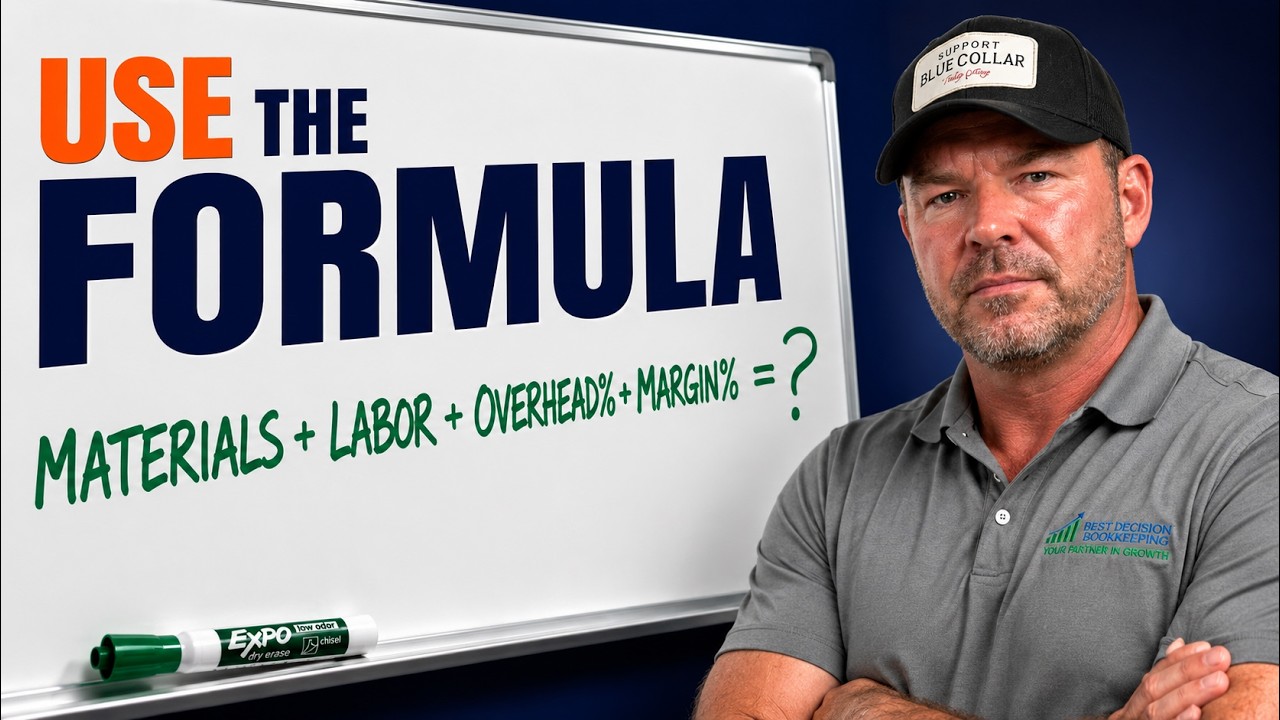
Companion toolkit
This screen gives you one bid. The toolkit makes it a system.
The simulator prices the job in front of you. The free Job Pricing Toolkit gives you the decision guide that walks the whole margin-vs-markup framework, plus the Excel workbook that runs single jobs, multi-line estimates, and a full sensitivity table — the same math, built to live next to your bid sheet.
- ■ Pricing Decision Guide (PDF) — the framework, the traps, and how to set your margin target
- ■ Job Pricing Simulator (Excel) — single-job calc, multi-line estimate, sensitivity table, cited methodology